Sunday, September 18, 2005

My Wife's Murder


RGV's new offering is an interesting effort. I felt the title was a little misleading. Visions of a slick whodunit appear. But this is not one of those. And the film is all the better for it. The film tells the tale of an average, middle class man (Anil Kapoor) who accidentally ends up killing his wife (Suchitra Krishnamurty) during a domestic fight. He considers going to the police, but is scared and is worried about the future of his little children. So he chooses to dispose off the body, wipe out all evidence and pretend that his wife had left home and never returned. His assistant from work (Nandana Sen) helps him out during all this. However, the police (Boman Irani) suspect foul play and attempt to track down the killer after the body is found.
The film is good. No songs and unnecessary frills to impede the narrative. It stays on track all through. The film chooses to focus on the psyche of a scared man on the run rather than turning it into a mystery/suspense thriller. Smart move, as I think this hasn't been explored in Hindi cinema to this depth before. It is quite plausible that a large number of people would react in a similar manner when faced with such situations. The film maker tries to explore the consequences of such a reaction.
Commercial success has eluded the film so far. Understandable, given that this subject will not appeal to all audiences. Anil Kapoor is fantastic as the unintentional wife murderer. The man never ceases to amaze. He gives a wonderfully understated performance, where he could have easily gone over the top and ruined things. The fact that he continues to experiment with his roles is commendable. Nandana Sen and Suchitra Krishnamurty are not bad. But the other acting highlight of the film is Boman Irani. His performance as the sadistic inspector hot on the 'murderer's' tail is exceptional. The man is full of suprises.
At two hours long, the film holds the viewer for most of the time. The only drawback might be the background music, which some might find a little too loud and jarring.

3/5

Cheers!
Abhishek.

Friday, September 16, 2005

Songs of a Lifetime - 2

The next song in the series.
This is the perfect traveller's tune, so to speak. I remember when I first left the country, this song used to sound so true. Still does. I guess one can use it as a metaphor for life. One is never stationary. You keep moving from place to place, from experience to experience and from time to time. In a sense, all of us are travellers.
Kishore's soulful rendition of this track makes it all the more special.
Film-Namkeen, Lyrics-That man Gulzar again!, Music-RD Burman, Vocals-Kishore Kumar

Rah pe rahte hain,
Yaadon pe basar karte hain,
Khush raho, ehele watan,
Hum to safar karte hain.

Jal gaye jo dhoop mein to, saaya ho gaye,
Aasman ka koi kona, thoda so gaye,
Jo guzar jaati hai, bas, uspe guzar karte hai.

Udte pairon ke tale jab beheti hai zameen,
Mudke ke humne koi manzil dekhi hi nahin,
Raat din, rah pe hum, shyaam o saher karte hain.

Aise ujde aashiyan mein, tinke ud gaye,
Bastiyon tak aate aate, raste mud gaye,
Hum thaher jaye jahan, usko shaher kahte hain.

Rah pe rahte hain,
Yaadon pe basar karte hain,
Khush raho, ehele watan,
Hum to safar karte hain.


Cheers!
Abhishek.

Thursday, September 15, 2005

Songs of a Lifetime - 1

Some songs will always stay with you. For ever. Maybe its the tune that works, maybe its the words that mean so much that you can't get it out of your system. These songs become like the soundtrack to your life, echoing in your head whenever an identifiable situation arises.
Here's the first in my series. One of the most beautiful songs ever penned by Gulzar. The film- Anand. Music- Salil Chowdhury. Lyrics- Gulzar. Vocals- Mukesh.

Maine tere liye hi saat rang ke sapne chune
Sapne surile sapne
Kuch hanste, kuch rote,
Tere aakhon ke saaye churaye, rasili yadoon ne.

Choti bate, choti choti baaton ki hai yaadein badi,
Bhule nahin, biti hui ek choti ghadi,
Janam janam se aakhein bichayi,
Tere liye in rahon main.

Bhole bhale, bhole bhale dil ko behelate rahein,
Tanhayi mein, tere khayalon ko sajate rahen,

Kabhi kabhi to aawaj dekar,
Mujhko jagaya khwabon ne.

Ruthi raate, ruthi hui raaton ko jagaya kabhie,
Tere liye, biti subhah ko bulaya kabhie,
Tere bina bhi, tere liye hi,
Diye jalaye ratoon mein.

Maine tere liye hi saat rang ke sapne chune
Sapne surile sapne
Kuch hanste, kuch rote,
Tere aakhon ke saaye churaye, rasili yadoon ne.

Cheers!
Abhishek.

Wednesday, September 14, 2005

Pommies to Ashes...Aussies to dust.


What a reversal of fortunes it has been. But then, fortune always favours the brave. And England has been the braver side throughout what will be remembered as one of the best Ashes series ever. Coming back from being one test down to winning the series takes some doing and England have done this with flair and fight. Its been a long wait since 1989 but the team now bears a solid look. The bowling attack is to die for, with Harmison, Hoggard, Flintoff and Jones. The batting order keeps firing regularly as well. And those two firebrands - Freddie Flintoff and Pietersen, have huge careers in front of them. Flintoff with his performance in this series has made a claim at Botham's exalted position.
The Australians put up a decent show, but they seemed a rag tag side with a lack of ideas. Though the Aussie spirit kept them from giving up without a fight, it was all a little too late. Those veterans McGrath and Warne tried their best, but a two man side is heavily on the wrong side of the odds.
The Australians as usual indulged in loose talk, mind games and attempts at mental disintegration, something that hasn't worked after Waugh's reign, but in the end were asked to look to the final score line, which read 'England 2, Australia 1' - Put that on the BBQ and cook it!

For now, England is delirious. About time.

Here's a link to Cricinfo's collection of Ashes 2005 quotes.

Cheers!
Abhishek.

Tuesday, September 13, 2005

The Nanyang MBA Series

I will soon be graduating from the the Full time Nanyang MBA programme at The Nanyang Business School here in Singapore. Its been a great year and a half (almost) to date and I must say that its been a ride I shall never forget. Its been made even more special by the many friends I've made here. I intend to put up a series (at what intervals, I don't know) on the MBA experience here, from its commencement in mid 2004 to date. The collective joys and sorrows, the late night discussions before exams, the 'have to crack this case' frustrations, the many rooftop gatherings and the life at the beautiful campus...just a few of the many things I intend to recapitulate through the blog. Its always sad when good things come to an end. But we'd like to believe that, from here, its only on to greater things!

PS: Batch mates beware!

Cheers!
Abhishek.

Monday, September 12, 2005

Quiz Time!

Quizzing is something that I've kind of lost touch with over the years. Participating in school and college Fests used to be a huge rush. It's taken a back seat for while now. Here are some questions, from the world of Cinema/Music/Arts, which have stuck over the years. Go ahead... test yourselves.

Questions:

1. Roland Joffe's 'City of Joy', had Om Puri playing the lead, Hasari Pal . Rumor has it that Puri didn't charge for the movie. He did, however, ask for one thing in compensation. What?
2. If SeaWind : Dirubhai Ambani, Pratiksha: Amitabh Bachchan, The Jet : ?
3. This one's easy. "Not to have seen the cinema of ____, means existing in the world without seeing the sun or the moon", said Akira Kurosawa, the great master of Japanese cinema, about a contemporary film maker of his time. Who was he talking about?
4. What is common to the following films; 'Awwal Number', 'Chamatkar' and 'AllRounder'?
5. How did Kundan Shah zero in on the names of his two heroes 'Vinod' and 'Sudhir' in the cult classic, 'Jaane Bhi Do Yaaro'?
6. This is for all those 'X-Files' fanatics. What's the significance of Mulder's apartment number, 42?
7. I am a vegetarian, suffer from asthma and myasthenia gravis, and got my first break in Bollywood with the help of a recommendation from Indira Gandhi. Who am I?
8. Lets see if you can guess the films which had the following closing lines:
a) “Men like my father cannot die. They are with me still, real in memory as they were in flesh, loving and beloved forever. How green was my valley then?”
b) “Madness. Madness.”
c) “I was cured all right.”
d) “This is Ripley, last survivor of the Nostromo, signing off.”
e) "Vanity - definitely my favorite sin."
9. This one is thanks to fellow blogger and batchmate, Cogito. How did the guys at Motorola come up with the name 'Six Sigma' for their quality excercise?
10. If 12 Angry Men:Ek Ruka Hua Faisla , Kramer Vs. Kramer: Akele Hum Akele Tum, then A Kiss From The Dying:?

Answers:

1. The rickshaw he pulled in the movie.
2. SD Burman. The name of the houses in which these celebrities stayed.
3. Of course, Satyajit Ray.
4. All had Cricket as the central theme.
5. They were named after Kundan Shah's assistant directors in the film, Vidhu Vinod Chopra and Sudhir Misra.
6. '42' is the ultimate answer to life, the universe and everything, according to Douglas Adam's 'The Hitch-hiker's Guide to the Galaxy'.
7. Amitabh Bachchan.
8.
a) How Green Was My Valley
b) Bridge On The River Kwai
c) A Clockwork Orange
d) Alien
e) The Devil's Advocate
9. People working on the project were huge fans of Pink Floyd. The band was originally called 'Sigma Six'. They just turned it around.
10. Baazigar. All the Hindi films were remakes of the listed English ones.

Cheers!
Abhishek.

Friday, September 09, 2005

A Tale of 21 heroes...


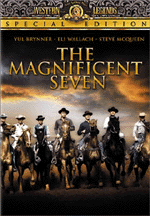
I was invited to a friend's place last week for a drink where I happened to chance upon his rather fascinating collection of old film posters. Being a film buff myself, I went through each and everyone of them. The ones that stood out where, 'Scarface', 'On the waterfront' and that John Sturges classic, 'The Magnificent Seven'. All original and and in mint condition.
The classic western brought visions of two other movies with almost identical themes rushing to mind. The Akira Kurosawa masterpiece, 'Seven Samurai' and our very own Raj Kumar Santoshi's 'China Gate'.
Kurosawa's 'Seven Samurai' has to be the best film in this genre. A motley group of hired firebrands bond together to vanquish a plundering enemy. In this 1954 film, a group of villagers hire samurai warriors to defend their village from bandits who regularly steal their harvests. They are so poor that they can offer nothing more than 3 meals a day our heroes ('the Magnificent seven were offered $20 each and our China Gate veterans mopped up more than a lakh...theres inflation for you!). Our men train and ready the village for the battle and succeed in defeating the bandits. The films strengths are its actors and its emphasis on human emotions, rather than on the action. The master's character sketching is near perfect and his use of deep focus would put Orson Welles to shame. He concentrates of human emotion and the bonding between the warriors and the villagers rather than on the action sequences (which are very raw and life like so if you're looking for fancy sword play and Jackie Chan-esque combat then go watch... a Jackie Chan movie!! duh!!). The bandits aren't sketched at all in this film. Shimura Takashi and Mifune Toshiro stand out amongst a stellar cast.
The 1960 remake by John Sturges was as good a Western as they come, but failed to capture that human quotient of the original, perhaps intentionally. The film was entertaining and made stars out of Steve McQueen, James Coburn and Charles Bronson. Yul Brynner plays the gunman with a heart of gold and leads a bunch of cowboys to protect a Mexican village from a roguish Elli Wallach. This movie borrows heavily from the original but focuses on the battle more than it does on drama. There is an interesting bit of trivia connected to the film. RJ Reynolds bought the theme song for $5000 and used it in their Marlboro commercials. Yul Brynner, who is often shown smoking in the movie, died of lung cancer in 1985. There are hints of heart in the movie, shown through Bronson's association with the village boys and McQueen's insistence on settling down after the 'final battle', but the focus is on the action. Loads on quick draws, duels and gun fighting here. Thoroughly enjoyable.
Santoshi's 'China Gate' was a rework of 'The Magnificent Seven', and in my opinion succeeded more than the original. The movie struck the right balance between action and drama. There were many issues here apart from the main purpose of 'daaku termination'. A bunch of aging, court martialled ex-army men out to prove to themselves that they were not deserters after all and still have some fight left in them. One of them is terminally ill, one has communal issues, and another is on the verge of suicide. Om Puri, Naseeruddin Shah, Danny Denzongpa and Amrish Puri put in solid acting performances. It also had that famous Urmila Matondkar item number, 'Chamma Chamma', which later appreared in 'Moulin Rouge'. The movie also introduced the talented Mukesh Tiwari as the larger than life dacoit. I quite love a good 'underdog Vs. huge odds' kind of film,(especially when the heroes have old age to contend with as well) and with a cast which showcases some of the best veteran talent in Hindi cinema including Jagdeep Jaffrey and Anjan Shrivastava. Very Bollywood, very smooth. Sameer Soni and Mamta Kulkarni provide the lighter love angle. An easy watch. You'll smile the most while watching this one!

My Ranking:

1. Seven Samurai
2. China Gate
3. Magnificent Seven

Any thoughts?

Cheers!
Abhishek.

Thursday, September 08, 2005

Tomake chai...


Walking down Cecile Street off Collyer Quay, during lunch time, I suddenly heard a voice call out, 'Dada, ki khobor?' Bengali. Sweet Bengali. But what was it doing here in the business district of Singapore? Not even Bengalis greeted each other that way here. In my heart of hearts, I hoped that it would be someone I knew, maybe an acquaintance from Calcutta here on holiday. I was dying to speak the language. But it was just some Bengali man greeting another one. They could have even been Bangladeshi, who knows? So much for my 'Singapore-Bong' theory... I guess Bongs did greet each other that way here after all.
Perhaps I was home sick. Perhaps I had heard that distinct accent after ages. I don't know. For a moment I almost considered walking up to them and joining in their conversation. But I didn't. I headed back to work. I guess it made me wonder. I have learned to appreciate 'home' (Calcutta/India) much more, after I actually left it in early 2004. I guess its true for most people living outside the country. Its strange how we don't cherish something enough when we have it. I have listened to more Hindi and Bengali-band music here, than in Calcutta. I jump at the opportunity of watching an Indian film much more now. As little as a cup of tea makes me all nostalgic. Make no mistake. I love it here. The place is great, the people very friendly. However, Calcutta doesn't let itself out of my system. And thats a good thing.
Listed below are few of things I miss the most about my 'City of Joy'.

1. The lingo : The mini-bus conductor going, 'aaste ladies', the para-dada admonishing his cronies, 'durr shala', the call of the workers on strike, 'cholbe na, cholbe na!' and the news reader going, 'aajker bishesh bishesh khobor'.

2. Very few things in life will match up to the combined pleasure of the following : A cold winter morning. Tea in an earthen cup ('bhaand'). A cigarette.

3. The 'Addas' : Bengali for a session of extended 'gup-shup', these invigorating sessions are used to discuss anything from particle physics to the neighbor's pretty daughter.

4. The Pujas : The Durga puja. The crazy crowds. The colour. The idols. The all night 'pandal hopping'. The laughs you share with your friends. The new clothes. The joy in the air. The city. The magic.

5. The people : You can hate the traffic jams and the strikes, but you have just got to love the Bengali. Where else in the world can you have a conversation, with just about any average-Joe on the street, about why Buddhadeb is doing a good job as CM, future prospects of the Indian cricket team - short and long term, how we are falling behind China in the growth statistics, and what needs to be done about global warming?

6. The Anjan Dutta song, 'Aakash bhora surjo tara', which says everything I'm trying to say far more eloquently.

Cheers!
Abhishek.

Wednesday, September 07, 2005

Triumph and Heartbreak


This week saw India lose another final at the 'Ind-Zim-NZ' triangular tourney and it also saw an unlikely hero in teenager Sania Mirza, who reached Round 4 of the US Open.
Sania's dream run was ended by none other than the reigning glam queen of the sport, Maria Sharapova. The scoreline of the hour long match read 6-2, 6-1. However the match was a little more hard fought than that. Sania put up a solid fight in every game and managed to stress Maria's serve. Sania's got talent but she really has got to do something about that serve of her's. Geoff Boycott's mum could smash that back for a down the line winner with a walking stick! Anyways, she did a great job. You go, girl!
Now lets talk about those 'Men in Blue'. Given that the team had a great run from 2001 to 2004, one can allow them a period of mediocrity for a while. They'd better get their act together before the World Cup, though! The tournament had a few takeaways...Ganguly scoring routinely in double figures (hey it's an improvement,ya?), Pathan and Nehra bowling well (except in the finals, but we'll allow that...too much pressure after all!), Yuvi's and Kaif's return to form of sorts and Dhoni's batting. The newcomers (Venugopal Rao and Jai P Yadav) failed to impress in the opportunities that they got. Suresh Raina didn't get much of a chance. Dravid's slump is scary. Many will admit that the final was a game India should have won, but losing finals has become an art form with these guys... Its on to the test series now. One would hope for a 2-0 India scorecard, but let's not get too ahead of ourselves!

Cheers!
Abhishek.

Tuesday, September 06, 2005

Adoor Gopalakrishnan


This year's Dada Sahib Phalke Award has gone to the very deserving Adoor Gopalakrishnan. When I read the news I was suprised that he hadn't recieved it earlier. I guess I had just stopped following his films after the Mammooty starrer, 'Mathilukal'(1989).
He is truly one of the doyens of Indian cinema, single handedly responsible for putting Malayali cinema on the world map. He is the most decorated Indian film-maker after Satyajit Ray. He has also set up the Film Society of Kerala, 'Chalachitra', apart from actively taking part in the constitution of 'Chitralekha', Kerala's first Film Co-operative Society for film production.
All the nine films he directed, from 'Swayamvaram' to 'Nizhalkkuthu', were screened at several International film festivals and won him several National and International awards. He won the British Film Institute award for 'Elepathayam'. He also won National Film Awards four times for Best Director and three times for Best Script. The Nation honored him with the Padma Shree in 1984.

Filmography:

Swayamvaram, Kodiyettam, Elippathyam, Mukhamukham, Anantaram, Mathilukal, Vidheyan, Kathapurushan and Nizhalkkuthu.

To read an interview with the great man, follow this link.

Cheers!
Abhishek.

Jagte Raho


This 1956 classic was something I saw about a month ago but I somehow never got around to writing the review. Shambu and Amit Mitra co-direct this satire. It tells the tale of a simple villager(Raj Kapoor) who finds himself in Calcutta, hungry and thirsty. In his search for water, he walks into an apartment complex where he is seen and presumed a thief. The film tells the tale of his subsequent efforts at hiding in the complex and the hypocrisy that he encounters in middle class society.
A dark comedy, this is one of starkest films in Indian Cinema. Shambhu Mitra's direction is almost flawless and he takes the film forward through a series of episodes, unmasking the double standards in society. The village bumpkin stumbles into a number of different homes in his attempts to escape, and experiences various forms of depravity...drunkenness, gambling and counterfeiting. He sees adultery, clandestine love, a husband trying to steal his wife's jewelry to place a bet at the races, a rich drunk who wishes for his wife to more than entertain his friends, neighbors who fight for everything and a murderous counterfeiter. All of this happens when the whole complex is in search of the so-called thief. The thirsty villager finally gets to quench his thirst, thanks to a kind and pious woman(Nargis), in the last scene of the film. The film does a great job at asking us searching questions like looking at oneself before pointing fingers and also addresses issues of social apathy and mass hysteria. The depiction of the foibles and the insularity of the middle class almost jumps out at you and makes you cringe.
A huge strength of the film is the supporting cast. Ifthekar (as the resident 'dada', in the only young and non-policeman role I have seen him in), Pahari Sanyal (as the stealing husband), Motilal (as the wife-beater,in the most lovable drunk act ever filmed) and Nargis(the woman who gives the villager water, in the last of the famous RK-Nargis pairings) were all very believable. What can say about Salil Chowdhury's music? The sublime 'Zindagi Khwab hai' and 'Jago mohan pyare' start and finish the film respectively. Then there is that personal favorite, the bouncy 'Loshe wai wai', a song which unfortunately remains one Chowdhury's more underrated tunes.
The only drawback of the film is the fact that all episodes do not get equal time. The Motilal episode drags on needlessly while the alcohol-maker sequence ends far too quickly.
A classic movie, fit to be displayed proudly in your 'Satire' collection, right next to 'Jaane bhi do yaaro'.

4/5

Cheers!
Abhishek.

Monday, September 05, 2005

Best Cricket Books

As MS Dhoni clobbered a six to complete a great come-from-behind victory against Zimbabwe(though it needn't have been that way!), I received a phone call from a friend asking me if I had that book by Mike Brearley, 'The Art of Captaincy'. I obviously didn't and told him accordingly. My mind still on cricket, I looked up my University library's database for cricket books. Apart from 'The British specifications for leather covered Cricket Balls', I couldn't find half a decent title. Cricket books can make for very interesting reading for anyone with a working knowledge of the game. The players trying to get under each others' skins, the strategy behind every move on and off the field, the grit and the determination, the heroic performances and the camaraderie of a team. All great things to read about apart from being a great lesson in team building as well (all you 'organisational behavior' enthusiasts please take note) . Given below are some of the Cricket books I have read, which I actively recommend:

1. The Art of Captaincy (Mike Brearley) : One of the finest books written on leadership in sport, this masterpiece was the first instance of a writer applying principles of sport leadership to more general or business leadership. Very well written, replete with apt examples and still very relevant, this book is a must read.
Key takeaway: Brearley's man management skills - his knack of perfectly gauging each players' mental make up and using that knowledge to build team harmony.

2. A Corner of a Foreign Field: The Indian History of a British Sport (Ramchandra Guha) : A great book about the history of the sport in India. The author delves into the British colonization of the country, the history of Bombay and how the sport got to where it is today. Guha's writing is insightful and he lists key matches, innings, and events which have shaped the sport here. Fascinating read.
Key Takeaway: A great book about the history of Cricket in India. Snapshots of key cricketing moments in Indian Cricket.

3. The Cricketer Book of Cricket Disasters and Bizarre Records (Christopher Martin-Jenkins) : What can one say of the indomitable 'CMJ'? This book a great read. A humorous take on the game, it contains some genuinely funny incidents that occurred in various moments on the Cricket time-line. At just over 100 pages, it is a short book, with cartoons et all, urging the reader not to take the game too seriously.
Key Takeaway: Nothing other some good laughs and some interesting records!

Cheers!
Abhishek.

Saturday, September 03, 2005

In search of Truth - Musings of genius


This is something I always wanted to post. Rabindranath Tagore and Albert Einstein met twice in Caputh near Berlin in 1930 for a little tete-a-tete. The conversations between these 2 geniuses are fascinating. At times my limited mental faculties find it hard to comprehend the profundity of the exchange. However, it still makes for interesting reading. On one occasion they spoke of the different music styles in Asia and Europe, and in the second, they try to 'plumb the Truth' and is easily the more intellectual of the two meetings. You can read the whole conversation here.

Just a quote,
TAGORE: When our universe is in harmony with man, the eternal, we know it as truth, we feel it as beauty.
EINSTEIN: But this is a purely human conception of the universe, don't you think?

The great poet also had a very interesting conversation with the greatest science fiction writer of our time, HG Wells. They dicuss social and literary issues relevant to India. HG Wells actually suprises with his thorough knowledge of India and the state of affairs in then British colony. Read the whole conversation here. Geneva 1930. Fascinating.

Cheers!
Abhishek.

Friday, September 02, 2005

Viruddh


The knowledge of a dead son. The engulfing lonliness. A powerful adversary. The corrupt system.
These are few of the things that the elderly couple in Mahesh Manjarekar's 'Viruddh' have to fight against. The film tells the tale of a couple who's son is accidentally killed by a powerful politician's son. The departed soul is branded a drug peddlar with the help of the corrupt police. The parents are devasted but vow to fight the system for justice. Amitabh Bachchan and Sharmila Tagore essay the roles of the parents and what a fantanstic job they do! The comfort level the two achieved in their previous fims (Chupke Chupke, Faraar & Desh Premee) continues to be visible here as well. The two of them are absolutely brilliant. John Abraham plays the son and does a decent job. Amitabh Dayal, an actor with much potential, who was last seen in N Chandra's explosive 'Kagaar' plays the son's killer but doesn't get much scope.
The movie's obvious strengths are the lead pair, the lack of distracting songs and the first half. Sanjay Dutt, who has a 'dynamic' appearence in the film is also a pleasure to watch. However, the weaknesses are in plenty as well. The movie is clearly divided into two halves, the first where the director etches out the characters'. The days in the lives of the couple are wonderfully potrayed and are very enjoyable. The simple family conversations, the little idiosyncracies of the aged etc. are a delight to watch. The second half is, however, a bit of a let down. The film switches track from 'lifestyles of the elderly middleclass' to 'fight the system for revenge' all too suddenly and hence lacks continuity. Not much is shown in terms of the battle against the corrupt officers and politicians. In that regard, 'Dhoop' was a much superior film. Also the 'parents dealing with the death of their only son' angle could have been explored further (perhaps the director could have taken a leaf out of 'Saraansh'). Hence the hitherto smooth flow is suddenly hampered by a haphazard twin track. Another annoying element in this film is the blatant product placement. Nerolac, Western Union Money Transfer and a motor oil co. I can't seem to remember now all get screen time buttressed with taglines and ad jingles. The ending again is an oft repeated formulaic one. Nothing new there. Manjarekar's direction is good but this film will not rank in the league of his 'Vaastav' or 'Astitva'.
But it is an honest attempt at a genre that hasn't been a favourite with the audiences. Give it a go.

3/5

Cheers!
Abhishek.

Thursday, September 01, 2005

The Music of Bollywood


I was in Singapore's largest HMV store the other day, and since I had more than my usual time to spare, I ventured up to the third level which houses the Classical/Jazz/World music collections. My intent was to look for the Kronos Quartet's new album titled 'You've Stolen My Heart- Songs from RD Burman's Bollywood', which they have recorded with Asha Bhosle. Long time collaborator and tabla maestro, Zakir Hussain also makes an appearance on this CD. I was rather keen to give the string quartet's rendition of RD's tunes a listen. However, the CD was unavailable and and I was left with no other choice but to browse through their collection on world music (which is rather good actually). I came across an interesting 3 CD set called the 'Music of Bollywood' - a collection meant, no doubt, to showcase the quintessential film-pop music from Bollywood's movie assembly line. The track listing is available here.
I must say I was very disappointed with the collection. The album is extremely partial to the 70s and to Kishore Kumar(Personally, I have no problems with it being Kishore heavy, but ideally one is looking for a representative sample). What are songs like 'Pyar do pyar lo', 'Pyar mein dil pe' and 'Aila re' doing on CD1? (or for that matter on any CD). 'Jahan teri yeh nazar hai' (Kaalia) and 'Humma'(Bombay) are the only redeeming moments from an otherwise pathetic collection on CD1. CD2's tracklisting reads more like a Kishore Kumar retrospective. 'Jaanejaan', 'Pal pal dil ke paas', 'Dil aaj shayar hai' and 'Tera mujhse hai pahale' are all worthy inclusions. CD3 again meanders into mediocrity. Jagjit Singh's 'Hothon se chulo tum', Mohd. Rafi's 'Mera man tera pyasa' (Gambler) and Chitra's 'Kahna hi kya'(Bombay) are the saving graces of this deplorable collection. One could have altleast hoped for some more thought on the songs of this generation. No modern hits here with the exception on 'Tu mere samne (Darr) and 'Bahon ke darmiyan' (Khamoshi).
A Bollywood collection with just 2 Rafi songs, no Manna Dey, Mukesh or Hemant Kumar! A listener new to the world of Hindi film music is not going to like this compilation, I'm afraid. The makers seemed to have played a game of random selection to come up with this collection. And that's all this is, a haphazard, choppy and in the end a below-par attempt to showcase Bollywood music, which will disappoint classes and the masses equally.

1/5

Cheers!
Abhishek.

Tuesday, August 30, 2005

Sarkar

Ramgopal Varma's tribute to 'The Godfather' is engrossing fare.
The film was touted by some as being part 'Godfather' and part 'Life and times of Bal Thakaray'(whyever for, one wonders!). But the similarity with the politician's life is just cosmetic. The beads, the dhoti and the glasses. All similarities end there. Now on to the real story.
'Sarkar', Subhash Nagre, (Amitabh Bachchan) believes in the film's tagline, 'there are no rights or wrongs, only power'. He runs an underworld gang which works for the benefit of the people. Albeit the methods which he uses are illegal, he goes ahead and uses them anyway. The people swear by him. Due to his populist persona he is also a powerful cog in the state's political machinery, although he is outside of it. His elder son (KK Menon) assists him is this enterprise. Vishnu is hot headed, power hungry and careless. Shankar (Abhishek Bachchan) , the younger son, is educated, soft spoken and only mildly acquainted with this dark, murky world of crime, henchmen and politics. However, Sarkar is surrounded by mafia men who have had enough of his non profit, charitable ways and want to see him dead. A conspiracy is hatched, Nagre's own family members are used as pawns and he ends up in jail on charges of murder. How he overcomes this and how his son, Shankar Nagre, takes over the empire forms the crux of the story.
The film is good, no doubt. Amitabh's acting is great as usual. KK Menon is good as the bad son and Abhishek turns in a competant, understated performance as the younger son, slowly taking over his father's empire. The supporting cast is fabulous, although some of the actors like Supria Pathak, Rukhsar, Tanisha, Katrina Kaif and Anupam Kher get limited scope to display their talents. The director uses deep focus and close ups to convey the grim proceedings and to highlight the conflicts and the emotions that the characters are going through. Abhishek excels in this regard. His expressions are honest and spot on. But in using this technique, RGV slows down the pace of the film, in the post interval portions, considerably. At some points, I almost blurted, 'got the idea Mr. Varma, now get on with it!'. Another complaint is the cliched villain characterizations. The Chandraswamy clone and the South Indian Don have all been done time and time again by fellow makers of commercial cinema. One didn't expect them to reappear in RGV's 'Sarkar'.
The background score by Amar Mohile is another strength. It's sinister and draws the viewer into the story. And at just over 2 hours, the film is prefect in his length. Barring a few slow sequences, it keeps the viewer engrossed.

After a disappointing 'Naach', a return to form for Ramgopal Varma. Now we wait for 'RGV ka Sholay'!

3.5/5

Cheers!
Abhishek.

Trainspotting

This was one movie I always wanted to catch, and it was only a few days ago that I found a VCD. The story is based on the book by Irvine Welsh and stays suprisingly true to it. This 1996 film (starring Ewan Mcgregor and Robert Carlyle) is directed by Danny Boyle who did a fabulous job with 'Shallow Grave'(1994).
The plot revolves around the lives of a group of friends, each unique yet bound together by a common love for heroin. It deals with their trials and tribulations and examines why drug addicts use drugs in the first place. The movie tells it like it is and doesn't for once glorify drug use. The film is stark, real and contains some seriously disturbing as well as brilliant footage. The drug induced 'trips' of Mark Renton, the protagonist are enjoyable but get boring after a while. The film also tries to tackle issues like Scottish identity (the scene in the stunning Scottish countryside, where Mark vents his agnst against his English colonisers is a highlight). The film also deals with basic human emotions such as love, hate, honesty and deciet. The film follows the groups' lives to the end of a drug caper, after which we see Renton stealing the drug money on which all his friends had equal claim. The last scene leaves us wondering if he 'chooses life' or falls back into his meaningless heroin filled existence.
The comic scenes are both dark and poignant at the same time. The acting is good. The direction better. The only complaint being the thick Scottish accent. Those not versed with the Scottish accent may find Robert Carlyle's character virtually incomprehendable.

All in all, a short, dark and funny film about drugs.

3.5/5

Cheers!
Abhishek.

Monday, August 29, 2005

Main Aisa Hi Hoon

The pictures on the CD cover conjured up images of the Sean Penn starrer, 'I am Sam' or that Dustin Hoffman classic 'Rain Man'.
However, half an hour into the film and all hopes of any redemption are squashed. Ajay Devgan tries his best as an 'autistic' man with brain of a 7 year old (the filmmaker should have researched the term before using it), fighting for the custody of his daughter (you guessed it, also 7 years old!) but is badly let down by a slow script and an unispiring story line. Another half an hour into the movie and I could hear my room mate snoring! The story revolves around Ajay Devgan, a mentally challenged man, fighting the wealthy Anupam Kher (his child's grandfather) for the custody of his daughter. The story tries to drive home the point that money, wealth, intelligence and adulthood are not necessary qualities to make a good father. Care, love and innocence can do the trick just as well. The dialogues are cliched, the direction average and the music insipid. The supporting cast is adequate. I quite liked Esha Deol as the love starved junkie (mother of Devgan's child); Anjan Srivastava is always lovable, but kudos to Sushmita Sen for her potrayal of a career oriented lawyer, who agrees to fight for the underdog, Devgan. Her performance is finely nuanced.
You could safely give this one a miss...

1.5/5

Cheers!
Abhishek.

Friday, August 26, 2005

10 Best Hindi Film Soundtracks

This was a long time coming. I've been meaning to put up a list of my top-10 Hindi film soundtracks for a while now. Opinions in this regard will vary greatly and some degree of bias will creep in. This is completely subjective and film lovers could argue over such lists till the the cows come home. However I will attempt to attach some method to the madness by using the following parameters: lyrics, instrumentation, on screen fit and of course the tune itself. Another trait I was looking for in the soundtrack was for each and every song on it to be a classic, unlike the one hit wonder soundtracks of today. There are times when all of these just come together to create unforgettable moments in cinema, moments which live on for future generations to discover and enjoy. The list is not ranked in order, but is a collection of the ten musically richest soundtracks which, according to me, Hindi cinema would have been poorer without.

The List.

1. Baiju Bawra (1952)
Music: Naushad
Lyrics: Shakeel Badayuni

A true classic. Perhaps Naushad's definitive soundtrack. Contains classical gems like 'Man tarpat Hari' and 'Mohe bhool gaye sawariya'. Lets not forget Rafi's silken voice on 'Duniya ke rakhwale' and 'Tu ganga ki mauj'. The highlight for me is the jugalbandi with Ustad Amir Khan and Pt. DV Paluskar, 'Aaj gawat man mero'. A classical feast.
Trivia: Bharat Bhushan lost out to Dilip Kumar for the Filmfare award that year but won next year for 'Chaitanya Mahaprabhu'. Despite being a huge star in those years, he died in penury.

2. Shree 420 (1955)
Music: Shankar Jaikishan
Lyrics: Shailendra and Hajrat Jaipuri

I had a tough time deciding between this film and 'Awara', another Raj Kapoor classic. I decided to go with this one beacuse this soundtrack was more accessable than Awara. The anthemic 'Joota hai japaani' continues to introduce new generations to Shankar Jaikishan's brilliance. Manna Dey's singing complements the music directors' songs perfectly. 'Dil ka haal', 'Mud mud ke na dekh' and 'Ramaiya vastvaiya' were all great songs. There was also 'Pyar hua ikrar hua', which still conjures up the magic of the Raj Kapoor-Nargis pair in your head. You can see them standing in the rain with the umbrella...a true cinematic 'Kodak moment'. Also on the soundtrack were 'Ichak dana' and 'O jaanewale'.

3. Pyaasa (1957)
Music: SD Burman
Lyrics: Sahir Ludhiyanvi

Guru Dutt's masterpiece. SD Burman at his peak. Mohd. Rafi and Hemant Kumar. The combination is just sublime. Each and every track on this album is fabulous. We have the peppy 'Jaane kya tune kahi' and 'Sar jo tera chakraye' and the soulful and poignant 'Jaane woh kaise log the' by Hemant Kumar. Also contains one of the great duets of the time, 'Hum aap ki aankhon mein'. What can be said of Sahir's lyrical genius? 'Jaane woh kaise log the?'
Trivia: Apparently, 'Sar jo tera chakraye' was an RD Burman tune!

4. Madhumati (1958)
Music: Salil Choudhary
Lyrics: Shailendra

Bimal Roy's biggest hit. This tale of reincarnation had some amazing music and gave Salil Choudhary his only Filmfare award. Mukesh takes centre stage here with songs like 'Suhana safar' and 'Dil tadap tadap ke' (with Lata Mangeshkar). Evergreen songs like 'Ghadi ghadi mera dil dhadke' and the haunting 'Aaja re pardesi' give Lata Mangeshkar ample scope to stamp her class on the proceedings. Not one filler here.
Trivia: The story and script was actually by a gentleman named Ritwik Ghatak.

5. Chalti Ka Naam Gaadi (1958)
Music: SD Burman
Lyrics: Majrooh Sultanpuri

This Marx Brothers-esque laugh riot is still one of the most enjoyable comedies to come out of India's film factory. The Ganguly brothers team up with SD Burman to create a magical soundtrack which revels in its own lunacy! The songs were fun, peppy, bouncy and had a strong western influence. 'Baboo samjho ishare'(great singing by Manna Dey and Kishore Kumar), 'Paanch rupaiya barah aana' and 'Ek ladki bhigi bhagi si' were fun, fast paced and delightful. There was also the naughty love song, 'Haal kaisa hai janaab ka', which went on to become the Ceylon Radio song of the year in 1958. Majrooh's lyrics were brilliant in their simplicity. Baaaajuu...!!!
Trivia: The song 'Hum the woh thi' was influenced by a western tune. SD Burman didn't want to include the song, but was forced into doing so by Kishore Kumar.

6. Guide (1965)
Music: SD Burman
Lyrics: Shailendra

The evergreen Dev Anand's pinnacle. 'Dada Burman' at this time was at the peak of his powers. Guide's music broke records all over the country. It contained such mersmerising tracks such as 'Din dhal jaye', 'Tere mere sapne', 'Aaj phir jeene ki' and 'Piya tose naina'. And who could forget the only Kishore song on the album, 'Gata rahe mera dil'? The lyrics by Shailendra are touching and apt. The music is as evergreen as Dev 'Raju Guide' Anand.
Trivia: Guide was made in English as well, the script being written by Pearl S Buck (the author's only film script). However, it failed at the Box Office.

7. Ghar (1978)
Music: RD Burman
Lyrics: Gulzar

One of RD's more underrated movie scores. This Vinod Mehra-Rekha starrer didn't fare well at the box office and hence the music perhaps failed to catch on. It is a personal favourite. The Kishore/RD/Gulzar combination was simply unbeatable! Each and every track here is pure genius. Kishore Kumar and Lata Mangeshkar both get ample scope to display their versitality on the solos 'Phir wohi raat hai' and 'Aaj kal paaon' respectively. Then there is the classic duet 'Aap ki aankhon mein'. Then there is the other Lata classic 'Tere bina jiya jaaye na'. A solid effort by the indomitable 'Panchamda'.

8. Umrao Jaan (1981)
Music: Khayyam
Lyrics: Sharyar

Muzzafar Ali's masterpiece was a true musical gem. Khayyam's tunes were so apt for that era. The lyrics were amazing as well. It highlights the beauty and the depth of the Urdu language perfectly. High point in Rekha's career. I would also hasten to say that it was the same for Asha Bhosle. 'In aankhon ki masti', 'Dil cheez kya hai' and 'Yeh kya jagah hai doston' will stay with listener for ever. Personal favourite is the duet 'Zindgai jab bhi teri bazm mein'. Simply gorgeous.
Trivia: JP Dutta is making a remake of this classic with the possible choices of the lead being Priyanka Chopra or Aishwarya Rai! Shabana Azmi will play the lead's mother.

9. Ijaazat (1988)
Music: RD Burman
Lyrics: Gulzar

The RD/ Gulzar team at it again. The words, the music and the vocals. Very few times in the history of cinema have these three elements fused to make such magic. Asha Bhosle's singing leaves you breathless. 'Mera kuch saaman' has to go down as one of the best songs ever written in the history of Hindi cinema. Asha's singing on 'Choti si kahani' and 'Khali haath shaam' is her best ever. Not to forget 'Katra katra', a track on which RD introduced twin track recording to Indian cinema. The richness of this album leaves you spellbound.

10. Dilwale Dulhaniya Le Jayenge (1995)
Music: Jatin Lalit
Lyrics: Anand Bakshi

The last of the modern classics. A hge hit, this established Shah Rukh Khan and Kajol as huge stars. Sometimes the soundtrack of the film is the true star, which was the case with this film. The banjo heavy 'Tujhe dekha to ye jaana' went on to be the love anthem of the 90s. The whole album had a peppy, upbeat feel to it. 'Zara sa jhoom loon' and 'Ruk jaa o dil deewane' are examples. 'Ho gaya hai' also showcases the veteren Lata Mangeshkar's versitality. This album also spawned the wedding anthem of this generation,'Doli sajha ke rakhna'. Jatin Lalit's swan song.

Phew! That took a lot of doing. There can be no absolute list as music is an individual experience. It was tough to leave out so many great pieces of work. The ones that narrowly missed out are:
Kaagaz Ke Phool, Abhimaan (SD Burman), Bees Saal Baad (Hemant Kumar), Anand (Salil Choudhury), Teesri Manzil, Aradhana, Amar Prem, Aandhi, Hum Kisi Se Kam Nahi, Masoom, 1942- A Love Story (RD Burman), Alam Ara, Mausam ( Madan Mohan), Utsav (Laxmikant Pyarelal) , Kashmir Ki Kali, CID (OP Nayyar) , Qayamat se Qayamat Tak (Anand Milind) and Dil Se (AR Rahman).

Cheers!
Abhishek.

Wednesday, August 24, 2005

Do Anjaane

I happened to catch this movie on VCD one day at campus. This was a movie I had seen ages ago and hence decided to give it another watch. All in all, it was a decent experience.
Amitabh Bachchan and Rekha play husband and wife, who both want different things from life. He wants family, social acceptance and a steady career while she wants to be a dancing phenomenon, a star. Since the husband feels guilty about having squashed his talented wife's starry dreams, the poor fellow has to loan funds from office to pay for his wife's lavish tastes. In the meanwhile they both dream of making it big someday, albeit in their own ways. In the midst of all this enters the husband's rich spoilt friend, played by Prem Chopra. He immediately falls for his friends wife and showers money and gifts on her. He also reintroduces her to the world of dance. The proximity between them grows. Of course, the husband dissapproves of this and confronts his friend, who promptly throws him off a running train. However, Hindi film heroes can never die before the climax and hence our man survives, only to lose his memory and be adopted by an indrustrialist (Pradeep Kumar) who believes him to be his long lost son.
Six years pass by, when in a minor accident our hero regains his memory and realises that he has a past (unfaithful wife, chocolate deprived son, et all) and vows revenge. He finds out that his wife is now a big star in Bengali cinema and that she has made it big with the help of his two-timing friend. With the help of a film director, Utpal Dutt, he sets out to destroy his friend and reclaim his neglected son.
A good movie to watch on a lazy sunday afternoon, when you have nothing better to do. It has good performances from the lead pair, Amitabh and Rekha. You can see the magic in the scenes they have together. This movie is also significant in regards to the fact that it has Mithun Chakravarty, in one of his first screen apprearances, playing an extra, the 'mohalle ka gunda' . Clearly, Utpal Dutt's potrayal of a scotch loving Bengali film director with a limited Hindi vocabulary has to go down as his second funniest performance in a Hindi movie after Golmaal. The music by Kalyanji Anandji is non to speak of.

A slice of typical 70's Bollywood. Enjoyable fare.

2.5/5

Cheers!
Abhishek.